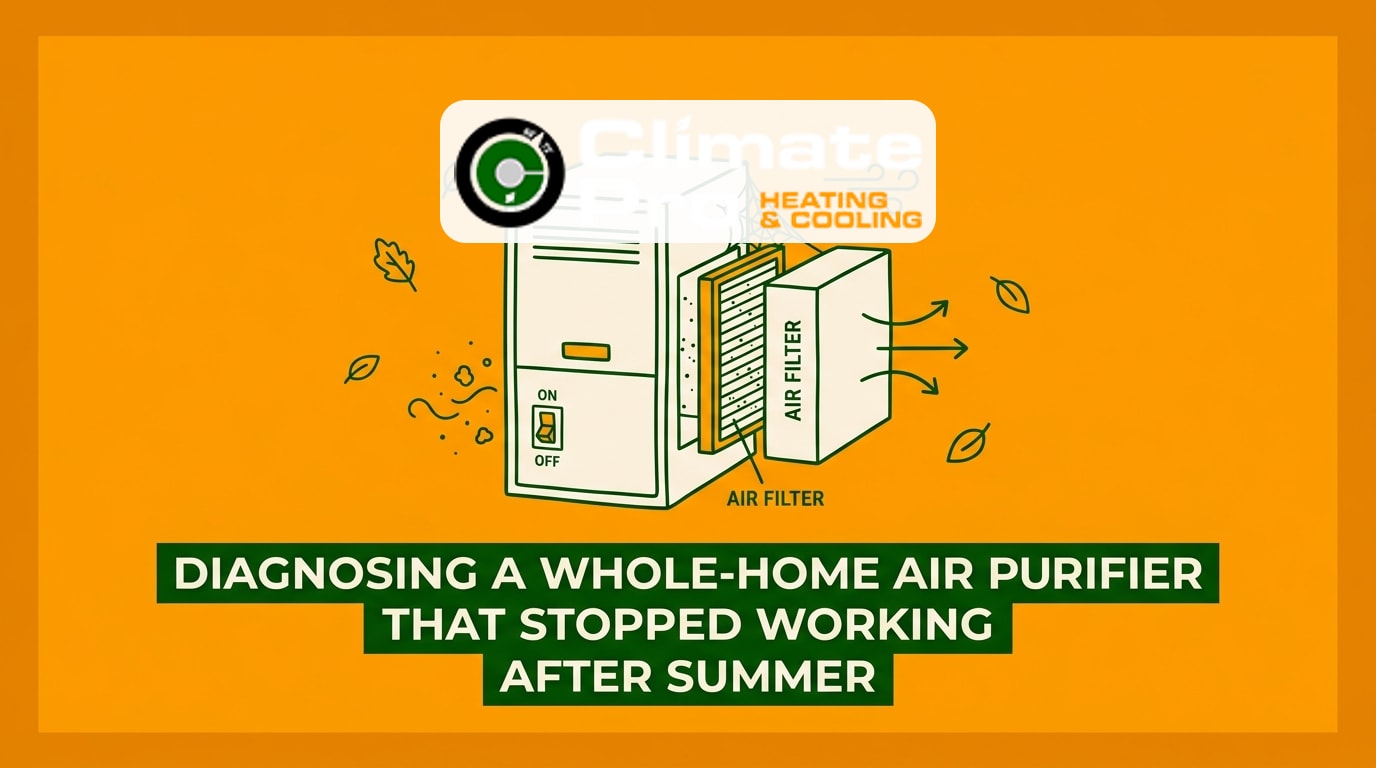
Why Is My Whole-Home Air Purifier Failing Just as Fall Begins?
Are you struggling with diagnosing a whole-home air purifier that stopped working after summer, right when you need it most? You are not alone. At Climate Pro Heating & Cooling, we receive countless calls every October as the fall heating startup begins, from homeowners discovering their integrated air purification unit is completely unresponsive. This timing is incredibly frustrating because the transition into cooler weather is exactly when you rely on these systems the most. As temperatures drop, we close our windows and seal our homes, which immediately traps indoor pollutants, allergens, and dust inside your living spaces.
Figuring out why your system failed requires understanding what it went through during the hotter months. The good news is that our team frequently finds many common issues can be resolved with a simple, safe homeowner fix. However, there is a strict line between safe troubleshooting and dangerous electrical work. By following a structured approach, you can rule out basic problems before deciding if you need professional indoor air quality services. This guide provides a safe, step-by-step checklist of what you can check yourself, helping you restore clean, healthy air to your home as the seasons change.
How Summer Wildfire Smoke and Heavy AC Usage Exhaust Air Purifiers
To understand why your system is failing now, you have to look at what it endured over the past few months. Heavy summer air conditioning runtime puts a massive, continuous strain on integrated whole-home purifiers. While your AC is running non-stop to keep your house cool, your air purifier is working overtime to scrub that massive volume of circulating air. Components that seemed perfectly fine back in June can be completely exhausted by October simply due to the sheer volume of air they have processed.
This is especially true in our experience serving the Everett WA and Pacific Northwest region. Our technicians see firsthand how unique environmental factors, including late-summer wildfire smoke, heavily load your filtration media with fine particulates. Furthermore, as we transition into fall, Everett’s average October humidity frequently exceeds 75%. This damp, cool climate creates the ideal indoor conditions for trapped moisture, mold spores, and mildew to thrive if your purifier is inactive. If you want to identify and eliminate common indoor air pollutants, you need a fully operational purification system before this damp weather settles in.
The Hidden Toll of Summer Particulates
Heavy particulate loads from summer conditions prematurely age almost every component of your indoor air quality system. When wildfire smoke and summer dust are pulled into your ductwork, your purifier works at maximum capacity to capture those microscopic invaders. This accelerated wear and tear means that, in our experience, maintenance schedules often need to be moved up.
Consider these factors:
- Increased pollutant concentration: The EPA notes that indoor air can be 2 to 5 times more polluted than outdoor air, especially when windows are tightly sealed for colder weather.
- Microscopic smoke particles: Wildfire smoke contains particles smaller than 2.5 microns, which clog fine filtration media much faster than standard household dust.
- Continuous airflow: Because your AC blower runs frequently during summer, the purifier processes millions of cubic feet of air, accelerating the degradation of filters and UV bulbs.
Step One: Verifying Power Supplies and Breakers Safely
When you begin troubleshooting, we always advise starting with the safest and most fundamental check: the power supply. A surprising number of air purifier issues we respond to are simply power interruptions. It is entirely possible to resolve a dead unit without ever opening a cabinet door. However, you must strictly observe DIY boundaries. Never open the purifier’s main chassis or interact with internal high-voltage wiring. If you need complex air scrubbing and purification solutions, leave the internal wiring to the experts.
- Check the main electrical panel: Locate your home’s main breaker box. Look for any tripped breakers, specifically those labeled for the HVAC system, furnace, or dedicated IAQ accessories. A power surge during a late summer storm might have tripped the circuit. If a breaker is tripped, reset it once. If it trips again immediately, stop and call a professional.
- Inspect the dedicated service switch: Most HVAC systems have a dedicated power switch mounted near the indoor unit. It looks just like a standard light switch. Sometimes, this switch gets bumped to the “Off” position accidentally while moving boxes or retrieving items from the garage or utility closet. Ensure it is flipped to the “On” position.
- Verify plug-in connections: If you have a plug-in style UV purifier or electronic air scrubber, trace the power cord from the unit to the wall outlet. Ensure it is firmly plugged in. You can test the outlet itself by plugging in a small lamp to verify the receptacle has active power.
- Check the GFCI reset: If your purifier is plugged into a GFCI outlet (common in basements, crawlspaces, or utility rooms), press the “Reset” button on the outlet to ensure it hasn’t tripped.

Step Two: Identifying and Replacing Clogged Pre-Filters
If your power supply is active but the system is still unresponsive or providing weak airflow, the next most common culprit our team encounters is a severely restricted filter. We regularly help homeowners deal with clogged pre-filters and burnt UV bulbs right at the October and fall heating startup. The pre-filter serves a critical function: it captures large dust particles, pet hair, and debris to protect the sensitive main purification cell or UV light from getting coated in grime.
When a pre-filter becomes completely clogged, it forms a dense wall of debris. You will often see heavy gray or black buildup on the media. This restriction severely chokes the airflow through your entire HVAC system. Modern whole-home purifiers and high-efficiency furnaces are equipped with sensitive safety switches. If the system detects that airflow has dropped below a safe threshold due to a clogged filter, it will automatically shut the purifier—and sometimes the entire furnace—down to prevent overheating and blower motor damage. Locating and safely swapping this pre-filter is a vital step in regular air filter replacement before the heavy demands of the heating season begin.
Why Pre-Filters Fail Faster in Late Summer
The premature clogging of pre-filters is directly connected to summer environmental factors. During a typical year, a high-capacity pre-filter might last six months. However, when you factor in heavy summer AC circulation and the influx of regional wildfire smoke, we see that lifespan drop dramatically.
The impact of summer usage:
- Volume of air: Continuous AC operation means the filter is catching debris 15 to 20 hours a day, rather than the typical 5 to 8 hours during milder spring weather.
- Smoke particulates: Wildfire smoke contains sticky, resinous particles that bind to filter fibers, blinding the media much faster than dry household dust.
- Lifespan reduction: Under extreme summer conditions, a filter rated for 6 months might only last 3 months before it becomes a severe airflow restriction.
Step Three: Checking for Burnt UV Bulbs in Your IAQ System
If your system utilizes ultraviolet light to neutralize airborne pathogens, checking the status of the UV-C germicidal bulbs is your next step. Dealing with clogged pre-filters and burnt UV bulbs are the two most frequent maintenance tasks our technicians perform for these systems. UV purifiers are highly effective at neutralizing mold spores and bacteria, but the bulbs have a very specific, limited lifespan.
Standard UV-C bulbs in whole-home systems typically lose their effective germicidal strength after 9,000 to 12,000 hours of continuous operation. Since many of these systems are wired to run 24/7 to keep the HVAC coil clean, that translates to roughly 12 to 14 months of life.
How to safely check your UV bulb:
- Use the viewport: Most modern UV purifiers have a small, safely tinted viewport or an exterior LED indicator light on the chassis. Look through this port to see if there is a visible glow.
- Never open the unit while powered: You must never open the purifier cabinet to look directly at an exposed, powered UV bulb. UV-C light can cause severe, permanent damage to your eyes and skin in a matter of seconds.
- Understand the “blue glow” myth: It is crucial to understand that a bulb might still emit a visible blue glow even after its invisible germicidal UV-C effectiveness is completely gone.
- Check the installation date: The safest process for determining if a bulb replacement is due is to check the date it was last installed. If it has been running continuously since last summer, it is time for a replacement, regardless of whether it still glows.
Step Four: Understanding HVAC Blower Interlocks and Furnace Integration
A common pattern we see during the October and fall heating startup is homeowners assuming the air purifier is broken when it is actually operating exactly as designed. This confusion usually stems from how the purifier is integrated with your home’s main HVAC system.
The Problem: You look at your whole-home air purifier and notice the indicator lights are off, or you don’t hear the distinct hum of its internal fan. You assume the unit has failed.
The Cause: Many high-end indoor air quality systems feature an HVAC interlock. This means the purifier is specifically wired to only power on when the main furnace or AC blower motor is actively running. If your thermostat has satisfied the room temperature and shut the blower off, the air purifier will also power down. Additionally, your furnace has a safety door switch. If the blower compartment door is even slightly loose, this switch cuts power to the entire system, including your interlocked purifier.
The Solution: You can safely test this interlock feature using your thermostat. Switch your thermostat’s fan setting from “Auto” to “On.” This commands the HVAC blower to run continuously, regardless of the heating or cooling cycle. Once the blower engages, check your air purifier. If the purifier powers up and its indicator lights turn on, your system is perfectly fine—it was simply waiting for the blower to activate. If the purifier still remains dead while the fan is running, you have confirmed an operational failure that requires further attention. Also, double-check that the metal doors on your indoor furnace cabinet are firmly seated to ensure the safety door switch is engaged.
DIY Limits: When to Call a Professional for Indoor Air Quality Repairs
While checking power switches, replacing pre-filters, and verifying thermostat settings are safe tasks for any homeowner, there is a hard boundary where DIY troubleshooting must stop. Whole-home air purifiers are integrated directly into your central HVAC system and often utilize high-voltage components that are dangerous to handle without proper training.
Working with a professional ensures you receive safe, reliable solutions for complex indoor air quality system repairs. Our licensed technicians at Climate Pro Heating & Cooling have the diagnostic tools and expertise to safely test internal control boards, high-voltage ballasts, and integrated relays.
Definitive signs you need to call a professional:
- Frequent breaker trips: If resetting the breaker causes it to trip again immediately, you have a dead short in the wiring. Do not attempt to reset it a third time.
- Burnt electrical smells: If you detect an acrid, melting plastic, or ozone smell coming from your vents or the purifier cabinet, turn off the system immediately.
- Flashing error codes: Many modern electronic air cleaners feature LED panels that flash specific sequences when internal components fail. These require a technician’s manual to decode.
- Internal wiring issues: If the unit has power at the outlet but the internal ballast or transformer has failed, replacing these components requires interacting with high-voltage HVAC wiring.
- No power after interlock testing: If the furnace fan runs but the interlocked purifier remains dead, the 24-volt communication wire or sensing relay has likely failed.
Living in the Everett WA and Pacific Northwest region means dealing with long, damp winters. Proactive system maintenance before the deepest part of winter arrives is the best way to protect your home. Enrolling in a comprehensive HVAC maintenance plan ensures these complex IAQ systems are tested, cleaned, and calibrated by our experts every season.
Frequently Asked Questions About Air Purifier Malfunctions
Why is my whole-home air purifier not turning on?
Your purifier is likely experiencing a power interruption, such as a tripped breaker, an open furnace door triggering a safety switch, or a blown internal fuse. Before assuming the unit is broken, verify that the dedicated service switch near the furnace is in the “On” position and that your main electrical panel hasn’t tripped a circuit. If power is confirmed but the unit remains dead, a professional will need to test the internal power supply.
How do I check if my UV air purifier bulb is burnt out?
You should check the exterior indicator light or the safely tinted viewport on the chassis to see if the bulb is operating. You must never open the unit while powered to look at the bulb directly, as exposed UV-C light is highly dangerous to your eyes. Remember that dealing with clogged pre-filters and burnt UV bulbs is standard maintenance; even if the bulb still glows blue, it loses its germicidal effectiveness after about 9,000 to 12,000 hours and should be replaced annually.
Does my air purifier only run when the furnace is on?
Yes, most integrated whole-home systems are interlocked to operate only when the HVAC blower is actively circulating air through the ductwork. If the furnace fan is off, the purifier will remain in standby mode to conserve energy and prevent internal heat buildup. You can test this by turning your thermostat fan setting to “On” to force the blower to run and verify the purifier powers up.
Is there a reset button on my whole house air purifier?
Some models have a dedicated reset button specifically for filter or bulb replacement indicators, which is usually located near the main display or power switch. This button clears the flashing maintenance light after you have installed a new filter or UV bulb. However, if the unit has completely lost power, pressing the maintenance reset button will not restore operation; you will need to check your breakers instead.
How often should I replace the pre-filter on my whole-home system?
We typically recommend replacing the pre-filter every 3 to 6 months, but sooner if it has been exposed to heavy summer AC use or regional wildfire smoke. During periods of poor outdoor air quality, the filter media loads with particulates much faster than normal. Inspect the filter monthly; if you see a dense layer of gray or black buildup, it is time for a replacement to prevent airflow restrictions.
Ensure Healthy Indoor Air This Fall With Expert Diagnostics
While checking your power supplies, swapping out clogged filters, and verifying thermostat settings are safe and effective ways to start troubleshooting, internal diagnostics require the hands of an expert. Diagnosing a whole-home air purifier that stopped working after summer doesn’t have to be a stressful ordeal. By recognizing the limits of safe DIY checks, you protect both your equipment and your home.
As we head into the damp, cool months typical of the Everett WA and Pacific Northwest region, a properly functioning indoor air quality system is your best defense against trapped allergens, mold spores, and winter illnesses. Don’t wait until the middle of winter to address a failing system. Reach out to the Climate Pro Heating & Cooling team today to schedule an expert inspection, ensuring your home’s air remains clean, healthy, and comfortable all season long.